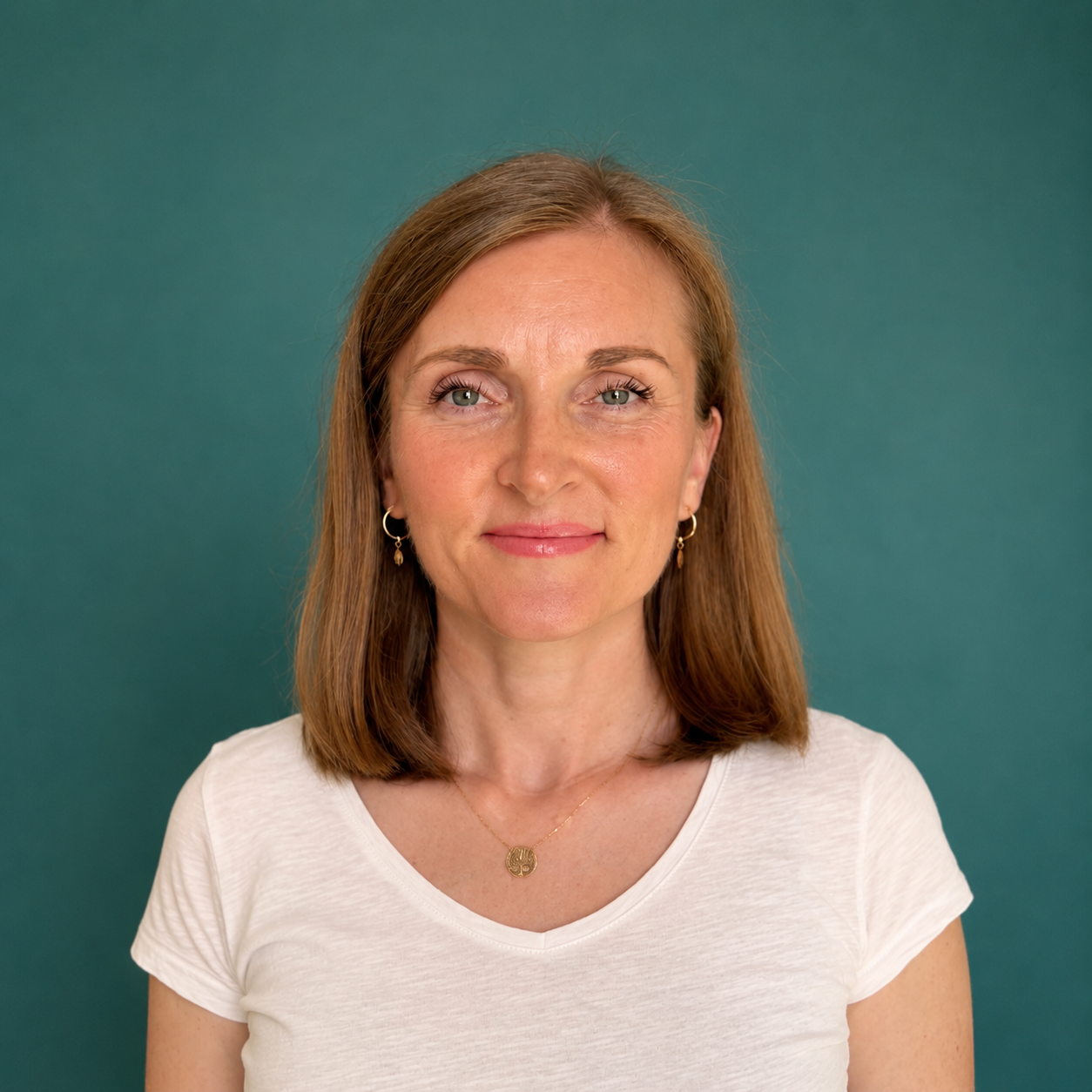
Lidia Pasztor
Yin
Yoga
Instructor
More than 12 years ago, I walked into a yoga studio in Cluj for the first time. Not because I was flexible or passionate about movement, but because my back hurt, my body felt stiff, and stress had left its mark on me.
I still remember that first class. Breathing seemed harder than any posture, my body trembled during the simplest movements, and the next day every muscle hurt. It wasn’t easy. And yet, something made me come back. Little by little, the pain began to decrease. My body became stronger and more mobile, while my mind became calmer.
That’s when I understood that yoga doesn’t only change the way you move, but also the way you live. The transformation I experienced inspired me to complete an accredited Hatha Yoga teacher training after moving to Bucharest. Since then, yoga has accompanied me every day and has become a part of who I am.
Over time, I felt that I was no longer looking only for a strong and flexible body, but also for more stillness, presence, and inner balance. That’s how I ended up in Greece, where I completed my Yin Yoga training — a practice that taught me the power of slowing down and listening to my own body.
Today I teach people who see themselves in my story: those who experience back pain, feel tired and stressed, and live at a fast pace.
I believe yoga is for every body, not just for those who are flexible. You don’t have to be in a certain shape to begin. You only need to be willing to give yourself a little time and a little patience.
In my classes, I want to guide you towards reconnecting with yourself, with more gentleness, presence, and authenticity. To leave with a more relaxed body, a calmer mind, and the feeling that you have done something good for yourself.
If you see yourself in my story, perhaps your journey can also begin with a single class.
🌿 Because yoga isn’t about perfect poses. It’s about feeling at home in your own body.
Services
- Reserve
Yin Yoga
70 lei
75 min
Group Session
🌙 What do we actually do in a Yin Yoga class?
Many people come to their first class without knowing exactly what to expect — it's not like dynamic yoga, but it's not ordinary stretching either. So today I want to explain a little about the mechanism behind it.
🧘♀️What does the practice look like:
We work with a small number of poses — usually 6-8 in one hour — but we hold them much longer than in other styles: between 3 and 5 minutes each, sometimes even longer.
The poses are passive. We don't use active muscular force to support them, but allow the weight of our body, helped by props (bolsters, cushions, blankets), to do the work. The muscles relax completely.
⏳Why does time matter?
Connective tissues — fascia, ligaments, tendons — need time and sustained pressure, rather than rapid movement, to release and gain real mobility. That's why holding a pose for 30 seconds does not have the same effect as holding it for 4 minutes.
👭What happens in the body:
The joints receive gentle stimulation, which nourishes them and helps maintain their health. The fascia — the tissue that surrounds the muscles and organs — becomes hydrated and more elastic. The parasympathetic nervous system is activated, the state of rest and digest, which explains the deep sense of calm at the end.
🧡How does it actually feel:
The first few minutes in a pose can feel slightly uncomfortable — not painful, but present. The body isn't used to staying in one place for so long. It's normal. Your breath helps you move through that threshold, and then, most of the time, a much deeper relaxation follows than you might have expected.
You don't need any experience or flexibility — every pose can be adapted with props, for every level.
Please arrive a few minutes early to have time to change.
I look forward to welcoming you 🤗
- Reserve
Yin Yoga Pass
230 lei
4 x 75 min
4 Group Sessions
🌙 What do we actually do in a Yin Yoga class?
Many people come to their first class without knowing exactly what to expect — it's not like dynamic yoga, but it's not ordinary stretching either. So today I want to explain a little about the mechanism behind it.
🧘♀️What does the practice look like:
We work with a small number of poses — usually 6-8 in one hour — but we hold them much longer than in other styles: between 3 and 5 minutes each, sometimes even longer.
The poses are passive. We don't use active muscular force to support them, but allow the weight of our body, helped by props (bolsters, cushions, blankets), to do the work. The muscles relax completely.
⏳Why does time matter?
Connective tissues — fascia, ligaments, tendons — need time and sustained pressure, rather than rapid movement, to release and gain real mobility. That's why holding a pose for 30 seconds does not have the same effect as holding it for 4 minutes.
👭What happens in the body:
The joints receive gentle stimulation, which nourishes them and helps maintain their health. The fascia — the tissue that surrounds the muscles and organs — becomes hydrated and more elastic. The parasympathetic nervous system is activated, the state of rest and digest, which explains the deep sense of calm at the end.
🧡How does it actually feel:
The first few minutes in a pose can feel slightly uncomfortable — not painful, but present. The body isn't used to staying in one place for so long. It's normal. Your breath helps you move through that threshold, and then, most of the time, a much deeper relaxation follows than you might have expected.
You don't need any experience or flexibility — every pose can be adapted with props, for every level.
Please arrive a few minutes early to have time to change.
I look forward to welcoming you 🤗
- Reserve
Yin Yoga Pass
390 lei
8 x 75 min
8 Group Sessions
🌙 What do we actually do in a Yin Yoga class?
Many people come to their first class without knowing exactly what to expect — it's not like dynamic yoga, but it's not ordinary stretching either. So today I want to explain a little about the mechanism behind it.
🧘♀️What does the practice look like:
We work with a small number of poses — usually 6-8 in one hour — but we hold them much longer than in other styles: between 3 and 5 minutes each, sometimes even longer.
The poses are passive. We don't use active muscular force to support them, but allow the weight of our body, helped by props (bolsters, cushions, blankets), to do the work. The muscles relax completely.
⏳Why does time matter?
Connective tissues — fascia, ligaments, tendons — need time and sustained pressure, rather than rapid movement, to release and gain real mobility. That's why holding a pose for 30 seconds does not have the same effect as holding it for 4 minutes.
👭What happens in the body:
The joints receive gentle stimulation, which nourishes them and helps maintain their health. The fascia — the tissue that surrounds the muscles and organs — becomes hydrated and more elastic. The parasympathetic nervous system is activated, the state of rest and digest, which explains the deep sense of calm at the end.
🧡How does it actually feel:
The first few minutes in a pose can feel slightly uncomfortable — not painful, but present. The body isn't used to staying in one place for so long. It's normal. Your breath helps you move through that threshold, and then, most of the time, a much deeper relaxation follows than you might have expected.
You don't need any experience or flexibility — every pose can be adapted with props, for every level.
Please arrive a few minutes early to have time to change.
I look forward to welcoming you 🤗
Contact
Location:
Harmonia Terra - Strada Cercului 18, BucureștiPhone:
0742850859Email:
pasztor_lidia@yahoo.comSocial: